What is measured?
Benchmarks define both a capability claim and a held-out evidence boundary.
Data-centric coding agents
A Survey of Data for Coding Agents
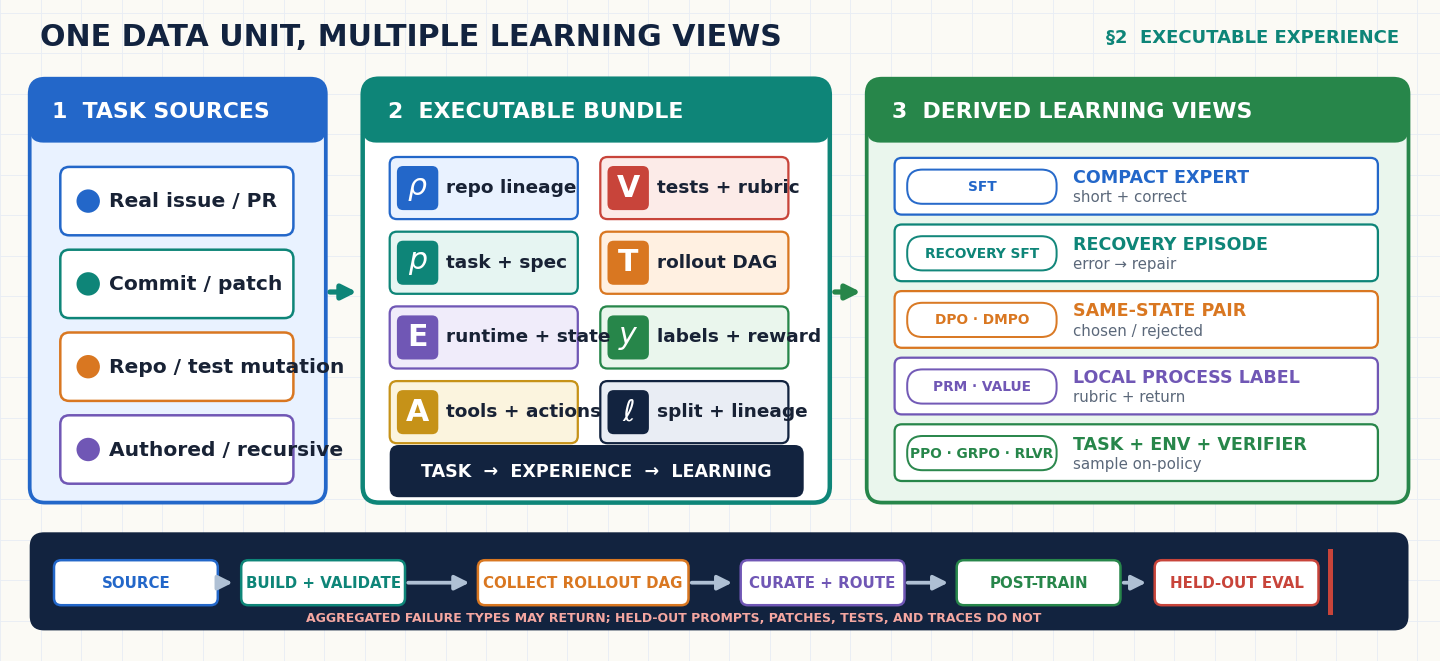
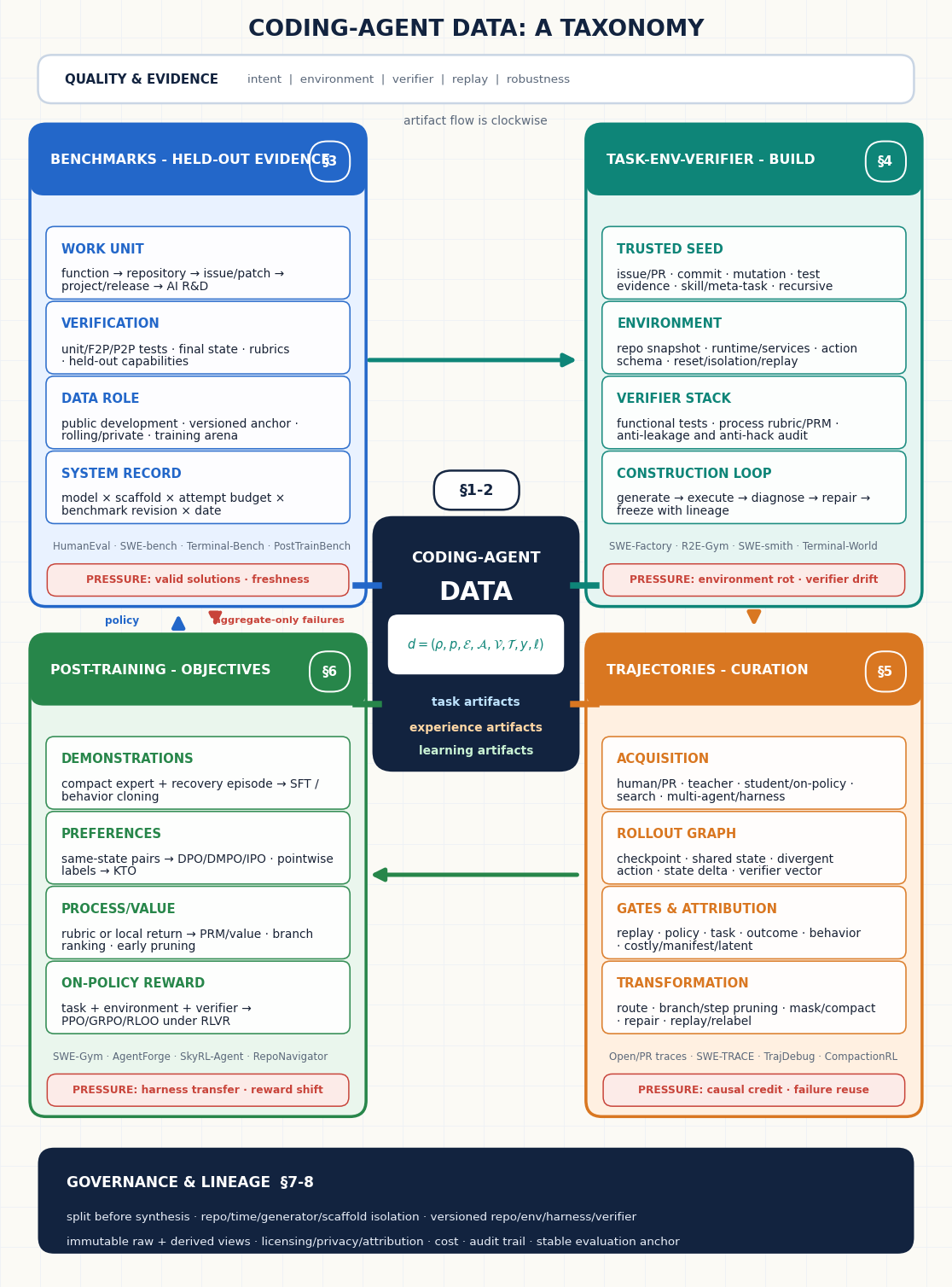
Coding-agent data is executable experience, not an isolated prompt–response pair.
01 Landscape
A useful datum binds the repository, visible task, environment, action interface, verifier, rollout graph, learning labels, and lineage into one versioned object.
Benchmarks define both a capability claim and a held-out evidence boundary.
Prompt, environment, verifier, and rubric must be constructed and validated together.
Rollout graphs preserve shared states, counterfactual branches, recovery, and cost.
Demonstrations, matched preferences, process evidence, and arenas serve different objectives.
dataset ≠ prompt collection
test pass ≠ task validity
trajectory ≠ flat transcript
RLVR ≠ optimizer
02 Benchmarks
The evaluation unit expands from isolated functions to repositories, issue repair, professional workflows, terminal state, and autonomous AI R&D. As the work unit grows, environment and verifier quality dominate prompt count.
unit tests
context + dependencies
F2P + P2P
feature · review · release
final machine state
trained checkpoint
Evaluation role
Training role
03 Task Factory
A natural-looking issue is not yet a valid agent task. The complete package must fail in the buggy state, pass under valid alternatives, reject near misses, replay stably, and expose no gold implementation.
issue · commit · test · skill
intent · constraints · difficulty
snapshot · runtime · reset
functional · process · audit
hash · version · lineage
Build, fail-to-pass, pass-to-pass, hidden behavior, mutation, and final-state assertions.
Grounding, evidence, recovery, efficiency, minimality, and calibrated process reward.
Future-history access, grader edits, vacuous passes, reward hacks, and sandbox escape.
04 Trajectories
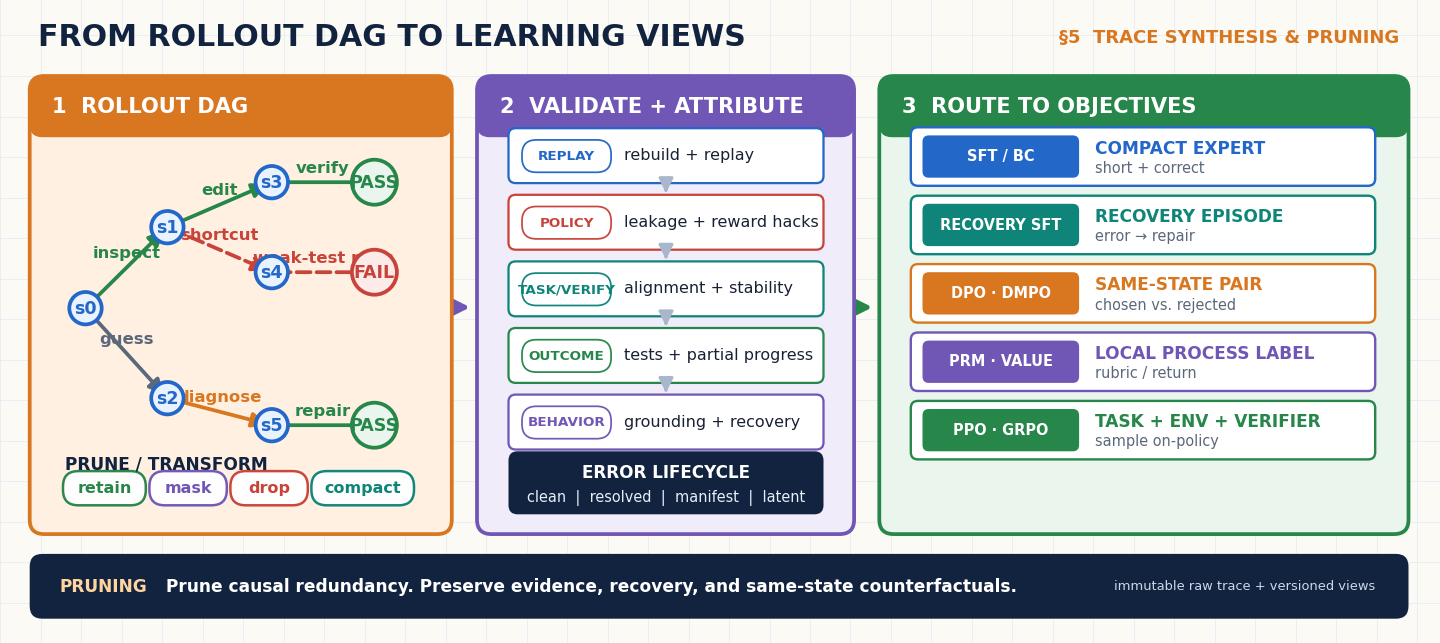
Shared checkpoints and divergent actions expose local counterfactuals. A passing trace can exploit a weak test; a failing branch can contain the evidence and recovery that teach robust behavior.
Outcome, policy audit, cost, and diversity decide the product—not success alone.
Preserve localization, diagnostic evidence, rollback, and corrected execution.
Create causally local chosen/rejected actions for preference or value learning.
Keep exact tools, paths, diffs, errors, and causal order while removing repetition.
05 Post-training
Experience source, supervision, policy relation, and credit granularity are independent axes. The data question comes before the optimizer name.
Do not collapse the taxonomy
PPO, GRPO, and RLOO are optimizer families. Rejection sampling is a data operator.
Credit granularity
Finer credit is useful only when its verifier or intervention supports the attribution.
06 Lifecycle & Frontiers
Immutable raw artifacts feed versioned training views. A frozen system crosses the evaluation firewall; only aggregate failure categories return to task construction.
How should a benchmark handle multiple valid solutions, contamination, and revision without losing comparability?
Can synthetic tasks transfer across repositories, languages, services, and naturally occurring maintenance work?
Which actions changed the reachable outcome, and which detours should be preserved as recovery?
Does a learned workflow survive new tools, context policies, action schemas, and verifier distributions?
What lineage, rights, cost, privacy, and reporting standard makes agent-generated data auditable?
07 Paper explorer
Explore 85 works from Awesome Data for Coding Agents, covering six branches and further reading. Descriptions and links follow the README snapshot of 26 September 2026. Works may appear under multiple filters.
0 works shown
No works match this filter.
08 Citation
Versioned draft · evidence frozen 18 August 2026 · website updated 19 August 2026.
@article{lin2026codingagentdata,
  title   = {From Issues to Learning Signals:
             A Survey of Data for Coding Agents},
  author  = {JLULLM LAB},
  year    = {2026},
  note    = {Survey manuscript},
  url     = {https://linjh1118.github.io/coding-agent-data/}
}